

























Certified Electrician Installing a Charging Station: The Complete Guide for Electric Vehicle Owners
The electric revolution on Israel's roads is already here, and more and more drivers are choosing to switch to electric vehicles (EVs) that contribute to the environment and save on fuel costs. However, purchasing a vehicle is only the first step. To enjoy maximum comfort and safe and efficient charging at home or in the office, there is a critical need to perform Installing charging stations בצורה מקצועית. כאן נכנס לתמונה איש המקצוע החשוב ביותר בתהליך: Licensed electrician Installing a charging station. במאמר זה נסקור לעומק את כל מה שאתם חייבים לדעת על התהליך, החל מהתקנות והבטיחות, דרך השלבים בשטח, ועד לעלויות הצפויות.
Why is it necessary to hire a certified electrician to install a charging station?
Many wonder if it is possible to save costs and use a 'handyman' or an electrician without a proper license to install the station. The unequivocal answer is no. Installing charging stations is a complex electrical job that requires specific expertise and compliance with the Israeli Electricity Law.
- Safety above all: Car charging station חשמלי צורכת זרם גבוה ורציף לאורך שעות רבות (במיוחד בעמדות תלת-פאזיות). התקנה לקויה, שימוש בכבלים בחתך לא מתאים או חיבור שגוי ללוח החשמל עלולים להוביל להתחממות יתר, קצרים, ואף לשריפות.
- Insurance validity and importer liability: Both insurance companies and car importers require an installation certificate signed by a qualified electrician. Without this certificate, in the event of damage to the vehicle or structure, you will find yourself without insurance coverage, and the vehicle warranty may be voided.
- Compliance with the requirements of the Electricity Law: The Electricity Law states that only a holder of a 'certified electrician' license (or a higher level, such as a chief electrician) is permitted to perform this type of work, which includes adding circuits to the panel, installing protective measures such as a fuse relay, and testing grounding.
Charging station installation process – step by step
When hiring a certified electrician to install a charging station, the process should be carried out in an orderly and systematic manner, with attention to every detail. Below are the key steps that every professional installer will perform:
Step 1: Site survey and preliminary infrastructure check
The first stage begins before the first cable is pulled. The electrician will check your electrical panel to make sure there is space for the new circuit and that the electrical company connection is adequate (a three-phase connection of 3×25 amps or more is usually recommended). A thorough inspection of the quality of the grounding in the structure will also be performed – iron conditions for a standard installation.
Step 2: Planning the installation route and laying the cables
At this stage, the route from the electrical panel to the vehicle parking lot is planned. The electrician will determine whether it is necessary to cut into walls, run cables inside existing pipes, or install external ducts. The type of cable must be adapted to the power of the station (for example, a 5×2.5 mm2 cable for an 11 kW station, or a 5×4 mm2 cable for a 22 kW station).
Step 3: Installing the protection components in the electrical panel
Each charging station requires a dedicated, separate power circuit. A qualified electrician installing a charging station will install an appropriate semi-automatic circuit breaker (SMCB) and a residual current device against electric shock. The device usually requires a type A residual current device, while if the station does not have internal DC leakage protection, a more expensive type B residual current device or a dedicated device for detecting direct current leakage will be required.
Step 4: Fixing the position and final checks
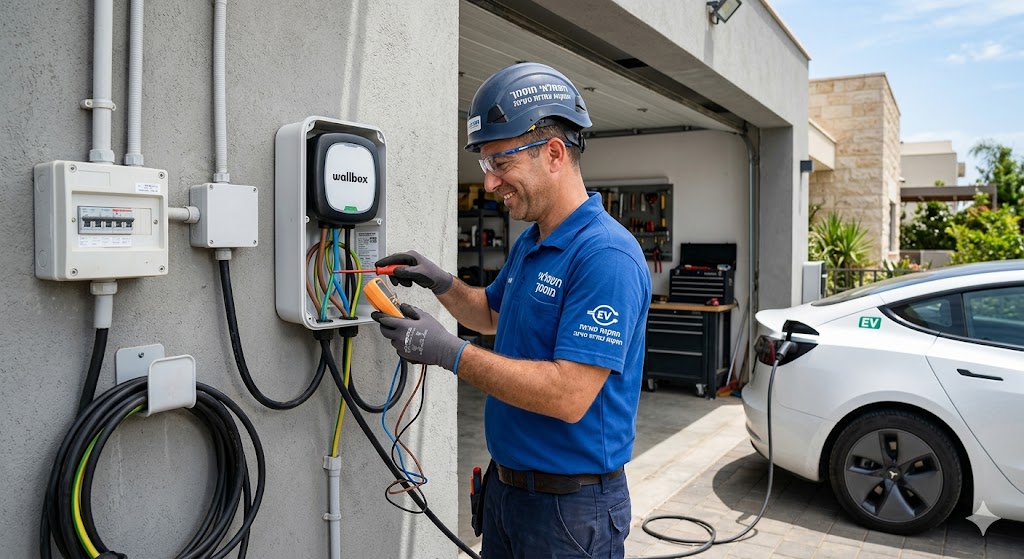
After connecting the cables, the station is fixed to the wall or a dedicated pole (pedestal). The electrician uses special testing equipment (charging station tester) that simulates a vehicle connection, to verify that the station is properly connected, that the grounding is correct, and that the fuse pops up in case of danger. At the end of the process, an official installation certificate will be issued for you.
How much does it cost to install an electric vehicle charging station?
The cost of installing charging stations varies depending on the complexity of the work, the distance from the electrical panel, the type of infrastructure required, and whether it is a private home or a condominium. Here is a table detailing the price ranges accepted in the Israeli market for the work of a qualified electrician:
| Type of work / installation component | Estimated price range (₪) | Professional comments |
|---|---|---|
| Basic and simple installation | 1,000 – 1,500 NIS | Includes pulling a cable up to 10 meters, without cutting, connection to the panel, and electrician approval. |
| Additional power cable (beyond 10 meters) | 40 – 80 NIS (per meter) | Depends on the type of cable (single-phase vs. three-phase) and route (duct vs. pipe). |
| Installing a dynamic load management system | 1,500 – 3,000 NIS | Prevents power outages in the home when overall power consumption is high. Highly recommended! |
| Installation in a condominium (complex) | 2,000 – 5,000 NIS | Usually requires drilling between floors, long ducts, and the installation of a secondary electrical cabinet. |
| Grounding inspection and repair | 350 – 1,200 NIS | If the preliminary inspection reveals that the grounding in the home does not meet the electrical standard. |
| Dedicated installation column (pedestal) | 800 – 1,500 NIS | Required when there is no nearby wall in the parking lot on which to hang the charging station. |
Installing charging stations in a private home opposite an apartment building
One of the biggest challenges that qualified electricians encounter is the fundamental difference between installation in a villa and installation in a condominium building.
Installation in a private home
In a private home, the process is relatively simple and quick. The electrician is solely responsible to the property owner, the cable route is usually short, and access to the main electrical panel is convenient. However, in cases where the home's electrical connection is small (e.g. 1×40 amps), the certified electrician will recommend upgrading the electrical connection with the electric company or installing a load management component to prevent system collapse.
Installation in a shared residential building
Installing charging stations in a condominium is a completely different story. First, the common property must be taken into account and sometimes the consent of the house committee and the building's residents must be obtained to transfer infrastructure in the public areas. Second, the distance from the apartment electrical cabinet to the underground parking lot can be dozens of meters, which makes laying the cable very expensive. In many cases, a qualified electrician installing a charging station will recommend connecting to the building's public panel, while installing a smart sub-meter that reads the tenant's specific electricity consumption, so that he can be financially offset against the house committee.
Tips for choosing the right electrician
Because the demand is huge, the market is flooded with installers. How do you know you're making the right choice?
- Ask to see a valid license: Don't be shy about asking to see the electrician's certificate and making sure that the license is valid and appears in the electricians' register at the Ministry of Labor. As mentioned, only a "certified electrician" or higher may perform the work.
- Specific experience in the field: Electrical work is a big world. Make sure the electrician has proven experience specifically in the field of installing charging stations. Ask to see a portfolio of work or recommendations from previous clients who have had similar installations done for them.
- Professional and liability insurance: Make sure that the electrician is insured with professional liability insurance, and that he gives you full written warranty for the installation, the quality of the materials, and the physical work.
- Design and aesthetics: A quality installer will not only ensure safety, but also visibility. Hiding cables, using proper conduit, and leaving a clean parking area are signs of a reliable and professional electrician.
Summary and recommendations for the future
Switching to an electric vehicle improves the driving experience and significantly reduces energy costs. However, don't settle for less than Certified electrician installing a charging station When it comes to the electrical infrastructure of your home or business, the safety of your family, the maintenance of your home electrical grid, and the validity of your car insurance depend entirely on the quality of the installation.
We always recommend conducting a market survey, requesting a detailed quote that includes all components (cables, switches, enclosures, and protective measures), and making sure that you receive a written and signed confirmation at the end of the process indicating that the work was performed by a licensed professional. Installing smart, standard charging stations will ensure you peace of mind and a smooth ride every morning.