



















A glazed balcony is the most beautiful room in the house in winter, and the most unusable in summer. Between April and October, it turns into a greenhouse: the glass lets in heat, the sun is blinding, the furniture fades, and the neighbors across the street see everything that happens. Tinting the balcony windows solves all of this in one working day, and it is also one of the most profitable jobs we perform: the difference in temperature is immediately noticeable. The first question everyone asks is how much it costs, and that is answered here in an organized manner: a price table by degree of tinting, what increases and what decreases the price, and what is important to check before ordering.
What is "window tinting" in practice?
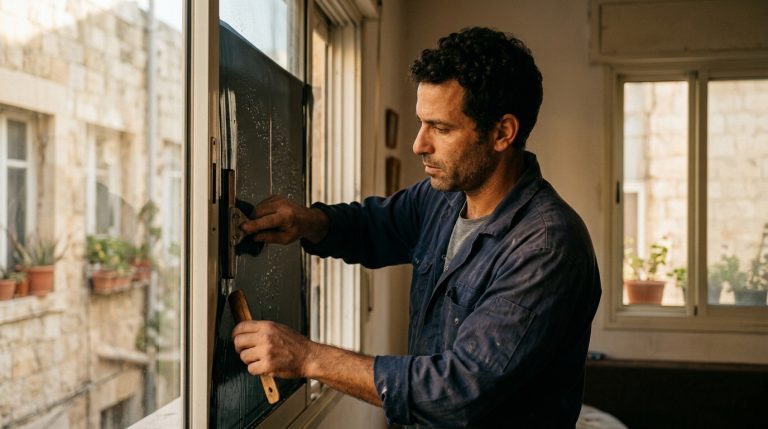
Window tinting is the application of a dark coating (film) to the inside of the glass. The coating is a thin polyester sheet with a color or metallic layer, which reduces the amount of light and heat that enters. "Tinting" is the popular name, but in practice there are several grades, ranging from a subtle smoke to almost opaque black, and several types of films that differ mainly in how much heat they block, not just how dark they are.
The point that most people are surprised by: Dark coating does not necessarily block heat. Cheap painted sheeting darkens but absorbs heat and radiates it in. Sheeting with a metallic layer reflects the heat back out. That's why on balconies we almost always recommend sheeting Anti-Sun Dark and not just about "color".
Price table – balcony window tinting
Prices per square meter of glass include material, professional installation, and warranty.
| Degree of blackening | What does it look like? | Suitable for | Price per square meter including installation |
|---|---|---|---|
| Light smoke (50% light transmission) | Reduces glare, almost imperceptible from the inside | A balcony that serves as a room, where you want to keep a view | 50–150 ₪ |
| Medium (35%) | The most popular shade, uniform appearance from the outside | Most balconies in residential buildings | 50–150 ₪ |
| Dark (20%) | High privacy during the day, strong heat blocking | South and west balconies, low floors | 100–300 ₪ |
| Black (5%) | Almost opaque on the outside, dark on the inside | Commercial facades, service balconies | 100–300 ₪ |
| Dark one-way mirror | Reflection from the outside, view from the inside | Those who want both privacy and a view | 100–300 ₪ |
The low range (50–150 NIS) refers to a basic painted sheet, the high range (100–300 NIS) to a metallic/anti-sun sheet that truly blocks heat. The final price in the offer is determined by grade, area, and number of wings, and includes material, installation, and warranty.
What affects the price?
The area of the glass. An average balcony in a residential building is 6-12 square meters of glass. The larger the area, the price per square meter decreases. A 15 square meter balcony will cost less per square meter than a 4 square meter balcony.
The type of sheet. Dyed sheeting is the cheapest but fades over time; metallic or ceramic sheeting is more expensive, truly blocks heat and lasts 10-15 years. We specify in the offer what type of sheeting.
Number of divisions. Enclosing a balcony with 8 small wings requires more cutting and smoothing than 3 large panes of glass.
Fixed or sliding glass. In sliding windows, it is sometimes necessary to disassemble the sash for cleaning and precise gluing at the edges.
The condition of the glass. Old stickers, silicone residue, or previous coating that needs to be removed add time.
Height and accessibility. A balcony with glass to the ceiling at a height of 2.8 meters or more requires a ladder and slower work.
Location. In the center of the country, there is no arrival surcharge for bookings above the minimum. For the far north and south, there is a travel surcharge that is agreed upon in advance.
What degree of blackening to choose?
This is the most important question, and this is where most people err on the side of "too dark." Three rules of thumb:
If the balcony is a room you sit in, don't go below 35%. In 20% and below, the balcony looks from the inside like a permanent cloudy day, and in the evening the light needs to be turned on early.
If the problem is heat and not privacy, choose a light-colored sun screen. A light metal sheet (50-70% light transmission) blocks 60-70% heat without darkening. This is what most customers really need.
If the problem is privacy from neighbors, choose a one-way mirror. During the day you can see out but not in. Important: At night, with a light on the balcony, the effect is reversed. Details in the guide on One-way window sticker.
And in any case: We bring samples of 3-4 shades and attach them to your glass before you decide. Shade 35% looks completely different on a north-facing balcony and a south-facing balcony.
What is allowed in a shared building?
In most buildings, there is no reason to blacken balcony windows from the inside, because it is not a change in the building envelope. However, in new buildings with design regulations or in evacuation-construction projects, there is sometimes a requirement for a uniform shade. It is worth checking with the building committee beforehand. Neutral-gray coating in grade 35% is the safe choice: it looks uniform and respectable from the outside and is not conspicuous.
What does the installation process look like?
- Price quote on WhatsApp. Send a picture of the balcony from the inside and approximate dimensions of the glass. You will receive a final offer the same day.
- Choosing a shade with samples at home.
- Cleaning the glass. Gentle, degreaser, and wiper tape. This is what ensures that the coating will last for years.
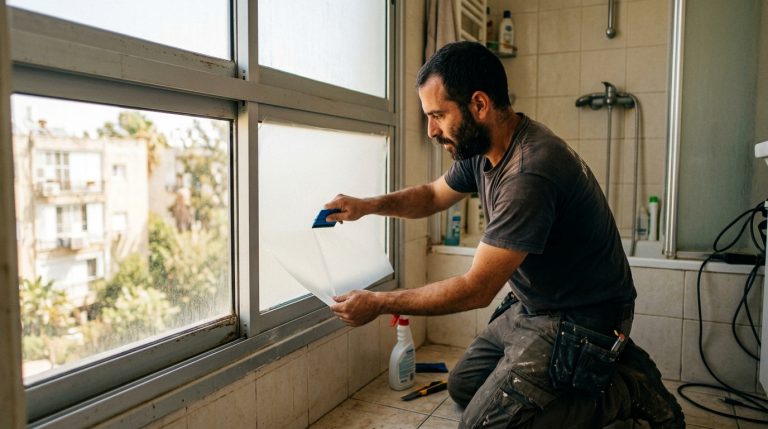
- Wet gluing and smoothing. The excess sheet is cut off, glued with a water solution, and smoothed until there is no water or air.
- Finishing and cutting edges. 1-2 mm from the frame, check against the light.
Average balcony: 2-3 hours. Full drying: 3-7 days, during which no cleaning or moving of wings is done.
How much does it really lower the fever?
A quality 35% grade anti-sun sheet blocks about 99% of UV radiation and about 60-75% of solar energy. On a west-facing balcony in Gush Dan, this is the difference between 38 degrees and 30 degrees in the afternoon, and between an air conditioner that fails to cool and a balcony you can sit on. The furniture, parquet and curtains stop fading, and this is a saving that is not seen in the electricity bill but is felt after two years.
Blackening versus alternatives
Curtains/blinds. They block out light completely, don't block heat from the glass, require cleaning, and take up space on a small balcony. The blackout works all day without touching.
Replacing glass with dark glass. 5-10 times the price, glazier's work with wing replacement, and irreversible. The coating gives a similar result in one day and can be removed.
A shade shed or pergola. Only solves the upper part, not the heat coming in from the side, and requires a permit in many cases.
Blackening according to the direction of the balcony
Western balcony. The sun is the strongest, from 2:00 PM until sunset. This is where a high-energy-blocking sun screen (65% and above) is required, at a level of 20-35%. This is the balcony where the investment pays off the fastest.
South-facing balcony. High sun most of the day. Grade 35% with good heat barrier is sufficient in most cases, and the lower part can be left brighter.
Eastern balcony. Low, blinding sun in the morning, cool in the afternoon. The problem is glare more than heat: Level 35-50% solves without darkening.
North balcony. Almost no direct sunlight. Here, the blackout is purely a matter of privacy, so Mirror sticker Or a light coating 50% is sufficient; a dark coating will make the balcony dark.
Closing a balcony with glass or aluminum - what is installed where?
In modern balcony enclosures (tempered glass in the wings), the coating is glued to the inside of each wing. It is important to disassemble or open the wings completely to reach the edges. In older enclosures with aluminum windows and plain glass, the coating is glued directly and also stops splinters in the event of breakage, an important safety advantage on balconies with children. When enclosing a balcony with double glass (double glazing), make sure to use a sheet designed for this purpose, to prevent thermal cracking; we check the type of glass before making a recommendation.
Common mistakes
Choose 5% for a residential balcony. Looks impressive from the outside, but inside it's a basement. For 95% from balconies 20-35% is correct.
Black out only to solve privacy at night. Dark coating does not hide at night when there is light on the balcony; from the outside you can see in. For privacy at night you need a milky or curtain.
Buy "dark coating" without heat blocking data. A painted sheet darkens without blocking heat, and in the summer the balcony remains warm, just darker. Ask for the percentage of energy blocking (TSER).
Stick on dirty glass or with old stickers. Within months you see bubbles and spots. Preparation is half the work.
maintenance
No cleaning for the first week. After that: mild soap and water, microfiber cloth or rubber squeegee. No ammonia, no abrasives, no knife. A coating treated this way lasts 10-15 years.
Examples from the field
9 square meter balcony in Rishon LeZion, facing west. Dark anti-sun 20% on the top and 35% on the bottom, to maintain a view of the street. Client: "The balcony has become a dining area again in the summer.".
Glazed service balcony in Petah Tikva, 4 square meters. Black 5% for complete privacy from the neighboring building. One hour of work.
Penthouse in Herzliya, 22 square meters of glass. A neutral one-way mirror around the entire perimeter, to maintain the sea view and hide the balcony from the building opposite.
Frequently Asked Questions
How much does it cost to blacken an average balcony? An average balcony in a residential building is 8–10 square meters of glass. According to the table, it is 400–1,500 NIS for a basic sheet and 800–3,000 NIS for a metal anti-sun sheet, depending on the grade and number of wings. Send a picture and dimensions and you will receive an exact number.
Does the blackening look like real "tinted glass" from the outside? Yes. A quality coating that is installed correctly looks as if the glass itself is dark. No edges, no bubbles.
Is it possible to darken only part of the glass? Yes. A common solution: dark on top against the sun, and light or transparent on the bottom for the view.
Does it block the view? At levels 35-50% the view remains clear, just without glare. At 20% and below the view is darker, like through sunglasses.
How long does it last? 10-15 years for metal or ceramic sheeting installed from the inside. Cheap painted sheets 2-4 years.
Can I install it myself? You can try, but large balcony glass is the most difficult to install yourself: a 2-meter sheet requires two pairs of hands, professional squeegee blades, and a lot of experience to avoid bubbles. Most of the removals we perform are self-installations.
Is there a warranty? Yes, on the sheet and during installation: against peeling, bubbles and discoloration.
Does it help in winter too? Anti-sun coating also reduces heat loss through the glass on cold nights, to a lesser extent. The main benefit in winter is reducing glare from the low sun.
How long until installation? The offer is usually received within the same week.
Blackout balcony windows throughout the country
We come to Tel Aviv, Ramat Gan, Givatayim, Holon, Bat Yam, Rishon Lezion, Petah Tikva, Herzliya, Raanana, Kfar Saba, Hod Hasharon, Modiin, Jerusalem, Netanya, Haifa, Beer Sheva and Ashdod. For more information on home coatings, see the full guide on Window coverings for the home – price.
How much does it cost to blackout a balcony by size – calculation examples
The quickest way to figure out what it will cost you is to calculate the glass area and multiply by the price range. Here are three typical balconies we encounter every week:
| Balcony type | Typical glass area | Basic sheet (50–150 NIS per square meter) | Metallic anti-sun (100–300 NIS per square meter) |
|---|---|---|---|
| Glazed service balcony | 3–5 square meters | 150–750 ₪ | 300–1,500 ₪ |
| Living room balcony in a residential building | 8–12 sq m | 400–1,800 ₪ | 800–3,600 ₪ |
| Large sun terrace / penthouse | 18–25 sq m | 900–3,750 ₪ | 1,800–7,500 ₪ |
How to measure: For each glass wing, width times height in centimeters, divided by 10,000. Add up all wings. A balcony with 6 wings of 80×220 cm = 6 × 1.76 = 10.5 square meters. On large balconies, the price per square meter drops to the low end of the range.
Balcony window tinting by region
Gush Dan (Tel Aviv, Ramat Gan, Givatayim, Holon, Bat Yam, Rishon LeZion, Petah Tikva). Most balconies here are enclosed with glass and face the building opposite. The demand is for a combination of privacy + heat, so a dark one-way mirror or anti-sun 20–35% are common choices. On western balconies on high floors, heat is the main problem: anti-sun with a high TSER.
Sharon (Herzliya, Raanana, Kfar Saba, Hod Hasharon, Netanya). Less dense construction, large sun terraces in cottages and low-rise buildings. Here they preserve the view: Neutral Anti-Sun 35–50%.
Jerusalem. Enclosed balconies serve as an extra room most of the year. Low-E glazing that reduces heat gain in the summer and heat loss in the winter is particularly cost-effective.
Haifa. Balconies with sea views and salty breezes. Corrosion-resistant, light-grade sheets so as not to lose the view.
Beer Sheva, Ashdod and Ashkelon. Extremely strong sun; uncoated glazed balcony reaches 40 degrees in summer. Anti-sun 20–35% with energy blocking of 65% and above.
Intelligence and new neighborhoods. Design regulations for the building facade. Neutral gray shade 35% is the choice that is almost always accepted.
What is included in the price and what is not?
The price per square meter including installation refers to:
- Sheet from a reputable manufacturer, of the agreed grade and type (painted, metallic or ceramic).
- Arrival at a place in the center of the country.
- Glass cleaning, including removing limescale and light silicone residue.
- Wet installation, precise cutting and edge finishing on each wing.
- Responsibility for the sheet and installation.
Not included, and priced separately:
- Removing old coating (20–40 minutes of work per wing, depending on the condition).
- Dismantling wings on old rails that do not open.
- Working at unusual heights (balconies with glass up to 3.5 meters or more).
- Travel to remote areas.
Blackening for service balcony, sun terrace and roof terrace
Glazed service balcony. Usually facing an internal courtyard or adjacent building, and used for laundry and storage. The goal is complete privacy: Black 5% or milky. One hour's work.
Sun terrace (enclosed living room terrace). The hottest room in the house in the summer. Here, you invest in metal or ceramic sheeting with a high energy blocking rating of 20–35%, and sometimes combine: dark at the top and lighter at eye level to preserve the view.
Roof terrace / penthouse. Large glass areas, sun from all directions, and sometimes wind. Weather-resistant exterior sheeting for glass that is not accessible from the inside, and interior for everything else. On roof terraces, we come to measure before providing a quote.
Balcony on the ground floor. Privacy from the street is the problem. One-way mirror during the day, and at night milky at the bottom or a curtain.
Glossary
VLT. The percentage of light that passes through the coating. The "grade" in the price chart.
TSER. The percentage of solar energy that the coating blocks. The number that determines how cool the balcony will be. Ask for it in the quote.
Painted sheet. The cheapest, darkens without really blocking heat, fades in 2–4 years.
Metal sheet. Reflects heat outward, lasts 10–15 years, has a slightly shiny appearance on the outside.
Ceramic sheet. Blocks heat without a metallic look and without interfering with cellular reception. The most expensive.
Thermal crack. A crack in double glazing caused by a heat-absorbing coating. Avoided by choosing the right sheet for double glazing.
Checklist before ordering balcony blackout
- Count the wings and measure each one (width × height of the glass).
- Photograph the balcony from inside at noon, when the sun is strongest.
- Write down what bothers you more: heat, glare, or privacy. This determines the type of screen.
- Check if the glass is double-glazed (you see two surfaces in the reflection).
- Check with the house committee if there is a requirement for a uniform color.
- Request in the proposal: type of sheet, grade, TSER, warranty and work time.
More questions about tinting balcony windows
Is it possible to blacken only the fixed wings and leave the opening ones transparent? Yes, and this is a common solution when you want to maintain a view in the part that opens. Note that the difference in shade will be visible from the outside.
What do you do with a balcony that is closed with glass shutters ("Louvre" shutters)? Glue each board individually. This is a slower job because of the number of small boards, and the price per square meter is on the higher end of the range.
Does blackout replace a curtain? During the day, yes: it provides privacy and blocks heat. At night, with a light on the balcony, you can see in from the outside, so anyone sitting on the balcony in the evening and wanting complete privacy should add a curtain or a blind at the bottom.
Does blackout also help the air conditioner on the balcony? Yes, and noticeably so. A balcony that receives 60–70% less solar energy cools down faster, and the air conditioner works less. Customers report a difference of several degrees during the afternoon.
Can it be glued to tempered glass? Yes. Tempered glass is the standard in modern balcony enclosures, and the coating is glued to it as usual.
Is there a difference between tinting a balcony and tinting car windows? The principle is similar, but the sheets are different: building sheets are designed for flat glass, large areas, and a durability of 10–15 years, and not for curved automotive glass.
What happens if a wing breaks in the future? We only apply new coating to the replaced wing. We maintain the sheet specifications to match the shade.
How long is the offer valid? 30 days. Prices vary according to the cost of the sheets, so we specify a date in the offer.
What to ask before closing with an installer
- What type of sheet? Painted, metallic or ceramic. The difference is between a coating that lasts 3 years and a coating that lasts 15.
- What is TSER? If the answer is "it's dark, it's blocking," look for someone else.
- Is the sheet suitable for double glazing? If your balcony has double glazing, it's a question of a thermal crack.
- What does the price include? Arrival, cleaning, finishing, warranty – or just "gluing".
- Do you bring examples for the balcony? Shade 35% on a west-facing balcony looks different than on a north-facing balcony.
Why choose retaining stones for balcony blackening?
Our installation team only works with professional sheets with specifications, comes with samples, and measures the balcony before a final quote. We tell you in advance what will and won't work (for example, that blackout doesn't solve privacy at night), and usually install within the same week. The quote includes everything: material, labor, arrival, and warranty.
When is the best time to order balcony blackout?
Most inquiries come to us in June-July, when the balcony is already unbearable, and this is also the peak of the load. Those who order in April-May get a faster turn and enjoy the balcony already at the beginning of summer. Autumn and winter are also suitable for installation: the sheet dries perfectly at temperatures of 15–25 degrees, and in winter you can comfortably check the shade on a sunny day. The only thing we avoid is installation on a rainy day with open wings, because high humidity prolongs drying.
Complete calculation example: 10 square meter balcony in Petah Tikva
Enclosed living room balcony with 5 wings of 90×220 cm, facing southwest, 4th floor, building opposite 15 meters away. The clients wanted both privacy during the day and to reduce heat. Area: 5 × 1.98 = 9.9 square meters. Recommendation: Metallic anti-sun sheet with reflection, grade 35%, TSER 65%. The price is in the range of 100–300 NIS per square meter, that is, between 990 and 2,970 NIS for the entire balcony, including material, installation and warranty; the final offer was determined according to the wings and the condition of the glass. Work time: two and a half hours. The result: a balcony that serves as a dining area even in July, and the neighbors across the street only see a reflection.
In conclusion
Blackout balcony windows Costs between 50 and 300 NIS per square meter, including installation, depending on the grade and area. It's a one-morning job that turns the balcony into a usable room all year round, protects the furniture and lowers the air conditioning bill. Send a photo and measurements to 052-444-0565 and you will receive a final quote the same day.