


























Wake up every morning with a fully charged battery
The biggest advantage of Electric vehicle It's not the quiet nor the quick jump at the traffic lights – it's the fact that you can say goodbye to gas stations. Your home becomes your own private gas station. You plug in your car at night, go to sleep, and wake up in the morning with a full battery for a new day.
But how exactly does it work? Can the car be connected to the kettle's outlet? And what is the difference between a regular cable and a fixed stand? At "Avni Ekhakot" we've sorted it out for you.
The two ways to charge at home: "Grandma's cable" versus a charging station
Broadly speaking, there are two methods for powering your car in your home's driveway. It's important to understand the critical difference between them.
1. Slow charging: standard household outlet ("grandma's cord")
Most electric vehicles come with a portable cable that connects to the vehicle on one side and to a standard household outlet (like the one on the inverter or toaster). This cable is known in professional parlance as a "grandmother cable" (Mode 2).
- How does it work? Just plug it into a wall outlet.
- Disadvantages: This is loading. Very slow. A full charge can take between 20 and 30 hours. Additionally, regular household outlets are not built to withstand high electrical loads for many hours, and using them can cause the outlet to overheat and burn out.
- When to use? Only in emergencies or as a temporary solution when staying with friends. It is not a permanent solution.
2. Recommended charging: Fixed charging station (Wallbox)
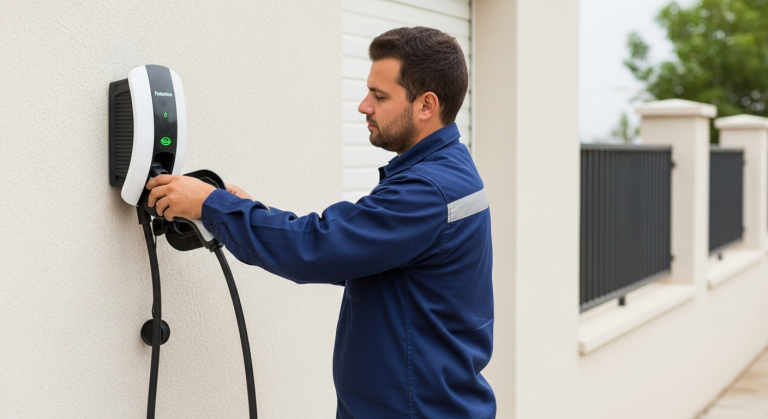
This is the correct, safest and fastest way. It is a smart box that is installed on the wall in the parking lot and connected directly to the electrical panel.
- How does it work? The station has a fixed cable (or a socket for your cable). You connect it to the car, and charging begins immediately or on a schedule.
- The advantages:
- speed: Full charge in 5-8 hours (in most vehicles). Significantly faster than a regular outlet.
- Safety: The stand is designed to transmit high current and comes with advanced protections.
- comfort: No need to take the cable out and back into the trunk every day. It's waiting for you on the wall.
The charging process: step by step
So you've installed a charging station (we'll explain how soon). How does the daily operation work? It's as simple as charging your smartphone.
- Connection: Park the vehicle, take the charging nozzle from the stand and connect it to the vehicle's charging socket (usually opened by pressing or via the vehicle's screen).
- locking: In most vehicles, charging will only begin after you lock the vehicle. Locking also "locks" the cable to the vehicle so it cannot be stolen.
- Indication: The charging light in the car (usually near the mouthpiece) will flash green (or blue, depending on the car) to confirm that current is flowing.
- ending: In the morning, or when the battery is full, open the car, disconnect the cable, and return it to its position. That's it, you're ready to go.
What do you need to install a charging station at home?
You can't just buy a stand on AliExpress and connect it yourself. This is an electrical infrastructure that requires professional installation.
- Infrastructure check: A certified electrician from "Avni Akhazot" will check whether your electrical panel can withstand the additional load (do you have a single-phase or three-phase connection?).
- Dedicated power line: We will install a separate, direct electrical line from the electrical panel to your parking space. It is prohibited to connect the stand to an electrical circuit that already has another device (such as an air conditioner or heater).
- Installing protections: Special protective circuit breakers (circuit breaker and fuse) will be installed in the electrical panel to protect your life and the life of the vehicle's battery.
Safety rules that must not be forgotten
When charging an electric vehicle, remember:
- Do not use a regular extension cord: Never plug your vehicle into a household extension cord (orange "roller" or white cord). They will melt and cause a fire in a short time.
- Plug-socket test: If you are still temporarily charging from a regular outlet, touch it occasionally (carefully) to make sure it is not hot.
- Authorized installation: Make sure the person installing the stand for you is a certified electrician.
Ready to move on to fast home charging?
Stop relying on expensive public positions or slow outlets.
At Avni Holdings, we provide a full service for installing charging stations: from inspecting the panel, through aesthetically pleasing paving of the infrastructure, to installing the station and training. Contact us today so you too can start your morning with a full battery.