




















If you've come here, the sun is probably shining too hard into the living room, the neighbors across the street can see too much, or the air conditioner is working overtime and not really helping. Window tinting for your home is one of the cheapest and quickest solutions to these three problems at once, but the first question everyone asks is the same: How much does it cost? In this guide, we'll answer it as directly as possible: a price table by type of tinting, what increases the price and what decreases it, and what's important to check before closing with an installer.
We at Avni Holdings have been installing window coverings in private homes, apartments and offices for years, nationwide – from Tel Aviv, Holon and Bat Yam to Jerusalem, Haifa and Beer Sheva. The prices in the guide are our actual prices, not estimates from the internet.
What is window covering anyway?
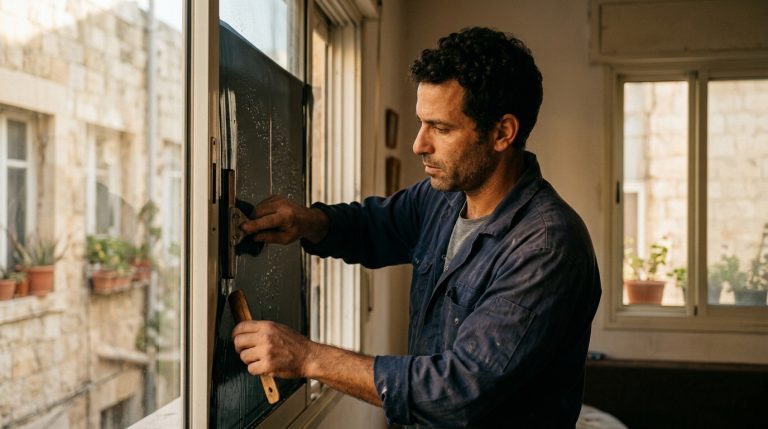
Window film is a very thin polyester sheet, tens of microns thick, that is glued to the existing glass from the inside. The sheet is transparent or painted, sometimes with a thin metallic layer, and it changes the properties of the glass without replacing it: blocks heat, filters radiation, hides the house from strangers or simply designs the window. The installation is done with soap and water, without dripping glue, and the result looks as if the glass itself was created this way.
The big advantage over replacing glass or installing blinds: the work takes just a few hours, not days, and the cost is usually one-tenth of replacing a window.
Price list – home window coverings
Prices include material and professional installation, per square meter of glass. Minimum order and arrival times are detailed below the table.
| Type of coating | Why is this appropriate? | Price per square meter (including installation) |
|---|---|---|
| Frosted coating | Privacy in shower, bedroom, balcony | 50–150 ₪ |
| Coating Anti-Sun (Blocks heat and radiation) | South-facing windows, sun balconies, air conditioning savings | 100–300 ₪ |
| One-way mirror coating (Reflective) | Privacy during the day without losing the view | 100–300 ₪ |
| Dark coating (Tint) | Glare reduction, uniform appearance for the front | Starting from 100 NIS |
| Anti-splinter safety coating | Large windows, houses with children, MMD | According to the thickness of the sheet – in the price quote |
| Decorative/printed coating | Shops, offices, glass partitions | 100–300 ₪ |
Prices are our work ranges per square meter and vary according to the type of sheet, quantity, and condition of the glass. The price quote you receive is final and includes material, installation, preliminary cleaning, and warranty. For small orders (single window), a minimum order applies, which is specified in the quote.
What affects the price?
The type of sheet. This is the most significant factor. A simple frosted coating is the cheapest; coatings with a metallic layer (anti-sun, mirror) are more expensive because they are made of several layers; safety coatings are thicker and therefore more expensive.
The number of meters. The more glass there is, the price per square meter goes down. A single window in a bathroom will cost more per square meter than an entire glazed balcony, because the arrival and preparation time is the same.
The size and shape of the windows. Large, regular (rectangular) windows are the fastest to install. Many small windows, curved glass, partitions with cutouts – all of these add work time.
The condition of the glass. Old glass with silicone residue, old stickers, or paint requires pre-cleaning, and sometimes removal of previous coating.
Height and accessibility. Windows at a height that requires a tall ladder or on a balcony without easy access are priced accordingly.
Location. We work all over the country; in the central region (Tel Aviv, Gush Dan, Sharon) there is no arrival surcharge for orders above the minimum. To the far north and south there is a travel surcharge that is agreed upon in advance.
Which coating is right for you? Quick comparison
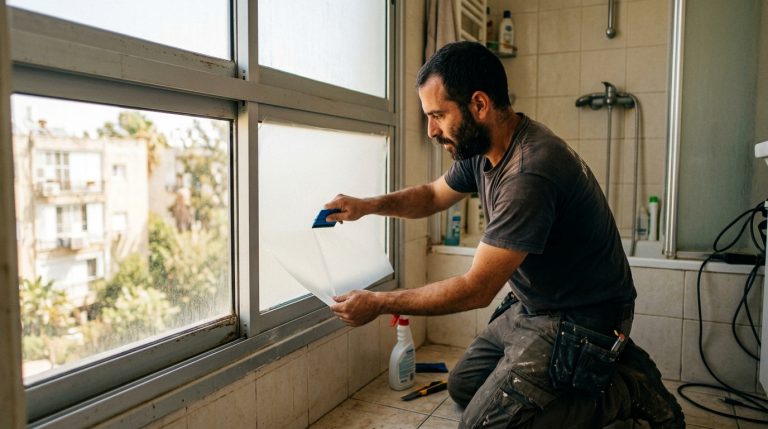
Want complete privacy, even at night? Frosted coating. It completely obscures what is behind the glass, letting in light but not reflection. Suitable for showers, bathroom windows, glass doors and bedrooms facing the street. Frosted window sticker It is our most popular choice.
Want to see out, but not be seen in? One-way mirror coating. During the day, the brighter side (outside) sees a reflection; you can see out as usual. Important to know: At night, when the light inside is stronger, the effect is reversed, so for bedrooms it is better to combine with a curtain. Details about Mirror sticker for the window.
Is the problem heat and sun? Anti-sun coating. Blocks up to 99% of UV radiation and up to 70-80% of solar heat, without darkening the house. The difference in room temperature is noticeable on the first day, and the air conditioner's electricity bill decreases. More about Sunscreen window coatings.
Dazzle and a unified front? Dark coating in various degrees (5%-50%). Common on balconies and office facades.
safety? A clear safety coating holds the glass in place if it breaks, so there are no flying shards. A must for those with small children near large display cases, and recommended forWindow protection against the top.
What does the installation process look like?
- Consultation and measurement call. You send us a picture of the windows and some basic measurements on WhatsApp, and you receive an accurate quote within hours. For large jobs, we come to measure.
- Choosing the coating. We bring physical examples of the coatings so you can see what it looks like on your window, in your lighting.
- Preparing the glass. Thorough cleaning with Scotch tape and degreaser. This is the step that determines whether the coating will last ten years or peel off after a winter.
- infection. The sheet is cut to size, glued with a water solution, and smoothed with a professional squeegee to remove all water and air.
- Finishing. Precise edge cutting along the frame and checking against the light.
Installation of an average apartment (4-6 windows) takes 2-3 hours. The coating dries completely in 3-7 days; until then, it should not be cleaned.
How long does a coating last?
A quality coating that is properly installed will last 10-15 years on an interior window. Exterior coatings (on the outside of the glass) last less, 5-7 years, due to exposure to the weather. The main reason for early failure is not the sheet but the installation: glass that was not cleaned properly or water that remained under the sheet.
Common mistakes to avoid
- Self-installation of a Mali Express roll. The cheap sheets peel, turn purple after one summer, and most importantly: they are very difficult to install without bubbles without tools and experience. Most of our customers who have tried on their own have us remove and reinstall, which costs more.
- Dark coating on old double glazing. Very dark coatings absorb heat and can crack double glazing with damaged edges. We test the type of glass before making a recommendation.
- Choose by price only. The difference of a few dozen shekels per square meter between a medium-quality sheet and a high-quality sheet is dwarfed by the cost of replacement after three years.
Window coverings by room – what goes where?
Living room and dining area. Here, the problem is usually heat and glare in the afternoon, especially in apartments facing west. Light or neutral-colored anti-sun coating preserves the view and natural light and lowers the temperature. If the windows face a nearby building, one-way mirror coating provides privacy during the day without sacrificing light.
Bedroom. Privacy is especially important at night, and that's when mirrored coverings don't work. The right solution is a frosted covering on the bottom of the window (up to eye level) and leaving the top transparent to light, or a full frosted covering combined with a blackout curtain.
Bathtub and shower. Milky coating is the standard. It is resistant to moisture and steam, easy to clean and does not peel off like a plastic curtain. In showers we usually stick Shower sticker Up to 1.6-1.8 meters high.
kitchen. Kitchen windows tend to accumulate grease, so it's important to choose a sheet with a top coating that's resistant to cleaning. Partial or decorative frosted coating also provides privacy from neighbors on the floor.
Glazed balcony (winter closure). This is where anti-sun coating pays off the fastest: large glass, intense heat in the summer, and a balcony that hasn't been used since mid-May. After coating, the balcony becomes a room again. You can also Black out the balcony windows In a uniform dark shade that looks great from the outside.
Roof and front windows. A 100-200 micron thick transparent safety coating holds the glass in place in the event of a bump or impact. It is not visible at all, and is often combined with an anti-sun coating in a single sheet.
Offices and glass partitions. Milky coating with a transparent stripe, cut logo or full print. Here the price per square meter is usually lower due to quantities, and we perform the installation in the evening so as not to interfere with work.
How to measure yourself for a quote
Measure the glass only, without the frame: width times height in centimeters. For example, a window of 120 cm by 150 cm is 1.8 square meters. Add up all the windows and send us a photo of each window – the photo helps us see if there are any divisions, double glazing, or old stickers. The price quote you receive will be final, not an "estimated price.".
Coating vs. Alternatives – Cost Comparison
Coating versus replacing glass with tempered/darkened glass. Replacing glass costs 5-10 times more than coating, requires glazing and sometimes frame replacement, and is not reversible. Coating gives 80-90% of the result at a tenth of the price.
Coating in front of electric shutters. A blind blocks out light completely, but a coating does not. If you want a dark room for watching a movie or sleeping during the day, a blackout blind or curtain is the solution; if you want to keep the light and view but no heat, coating wins by a wide margin in both price and maintenance.
Siding in front of curtains. A good curtain for a room costs as much as a covering for the same window, but needs washing, doesn't block heat from the glass itself (the heat is already inside), and doesn't provide privacy when open. Many of our customers install covering and leave a thin decorative curtain.
Smart glass front coating (Smart Film). Glass that changes from clear to frosted at the push of a button costs 15-20 times more than regular frosted glass. Impressive for conference rooms, unnecessary in most homes.
How to identify a quality sheet (and why it matters to the price)
Not all coatings are created equal, and the difference is not always visible on the day of installation. A quality sheet is made of optical polyester of uniform thickness, with a water-based adhesive layer (not regular glue) and with a scratch-resistant top coating. Cheap sheets are identified by several signs: a strong adhesive smell in the roll, a tendency to turn purple or lighten after summer, a "rainbow effect" of colors on the glass at a certain angle, and edges that lift after a few months. When we offer a price, we indicate the type of sheet and the manufacturer of the material. If you received a significantly cheaper offer without it saying what material the coating is made of, that is exactly why.
Another difference is in the "shading value" and heat blocking percentages, which are shown on each sheet’s technical sheet. A quality anti-sun coating will show UV blocking of 99% and solar energy blocking (TSER) of 50-80%. A sheet without such data is usually a decorative coating that darkens the window without actually blocking heat.
Short color guide
Neutral/transparent. The safe choice for the home: no matter the color of the light, it is not visible from the outside.
Smoke Gray 20-35%. Gives an elegant look to the facade and reduces glare without darkening too much.
bronze. Warms the light shade, popular in homes with wood and stone.
Silver/mirror. Maximum privacy during the day, modern look, not recommended for bedrooms without curtains.
milky. Transparent white, transmits 70-80% light and completely conceals.
Black 5%. Only for balconies and commercial facades; in the living room it gets too dark.
When window tinting is not the right solution
There are cases where we will honestly tell you that glazing will not help. If the glass is cracked or has a damaged seal, you need glazing first. If the problem is noise from the street, the coating is not acoustically insulated; for that you need double glazing. And if you want complete darkness during the day, a 5% dark coating still transmits light, and a shutter or blackout curtain will do the job better. In such cases, we will direct you to the right solution even if it is not ours – a satisfied customer is worth more than one installation.
Maintenance: How to maintain the coating
In the first week after installation, do not clean at all and do not open sliding windows that rub against the sheet. Then clean with water and mild soap with a microfiber cloth or rubber squeegee. Do not use ammonia, abrasives, or a razor. A coating treated in this way will look new even after a decade.
Examples from the field
Apartment in Givatayim, 5 living room windows and a study facing west. Neutral anti-sun coating was installed on all windows. The client reported that the air conditioner in the living room went from "maximum all afternoon" to "power 2", and the color of the sofa stopped fading.
Private house in Hod Hasharon, 14 square meter glazed balcony. A combination of dark 20% coating on the top and a clear anti-sun coating on the bottom, to preserve the view of the garden. One morning's work.
Clinic in Tel Aviv, glass partitions. Milky coating with a transparent stripe at eye level and a cut-out logo. Installation was performed on Friday after hours.
Window coverings throughout the country
Our team comes to Tel Aviv, Ramat Gan, Givatayim, Holon, Bat Yam, Rishon LeZion, Petah Tikva, Herzliya, Raanana, Kfar Saba, Hod Hasharon, Modiin, Jerusalem, Netanya, Haifa, Beer Sheva and Ashdod. For work outside the center, we coordinate several installations on the same day, so it is worth coordinating a few days in advance.
Frequently Asked Questions About Window Coating Prices
How much does it cost to cover one window in a bathroom? An average bathroom window is 0.5–1 square meters, meaning 50–150 NIS according to the price table, but when ordering a single window, there is a minimum order that covers arrival and preparation. Therefore, it is worth combining another window or two in the same visit, then the price per square meter drops.
Does the price include installation? Yes. All prices in the guide include the sheet, installation, preliminary cleaning and warranty. There are no hidden extras.
Is there a warranty? Yes, the installation and the sheet are guaranteed against peeling, bubbles and discoloration. The duration of the warranty depends on the type of coating and is specified in the price quote.
Can the coating be removed in the future? Yes. The coating is removed with heat and adhesive remover without damaging the glass. We also offer a removal and replacement service.
Siding or curtains – which is better? Coating works 24 hours a day without blocking light and view, does not require cleaning and does not take up space. Curtain provides complete darkness at night. Many customers combine: anti-sun or milky coating, and a light curtain for evenings.
Does window tinting really reduce heat? Yes, and in a measurable way. A high-quality anti-sun coating blocks 60-80% from the sun's energy; on a glazed balcony or in a west-facing living room, this is a difference of several degrees in the room.
How long does it take to receive a quote? Usually the same day. Send a picture of the windows and approximate dimensions to WhatsApp 052-444-0565.
Is it possible to install a coating on double-glazed (double-layer) glass? Yes, in most cases. It is only important to choose a coating that is suitable for double glazing (not too dark and does not absorb heat) to avoid creating thermal stress. We check the type of glass before making a recommendation.
Does coating also hide at night? Milky coating – yes, always. Mirror coating – only when your side is darker than the other side, that is, during the day. At night, with the lights on in the house, you can see inside, so for private rooms, milky or a combination with a curtain is recommended.
How much does it cost to remove old siding? Removal is priced per square meter and depends on the age of the coating and the amount of adhesive remaining. When removing and installing new in the same visit, removal is usually significantly discounted.
What is the difference between window tinting and window stickers? In practice, it's the same product: "sticker" is the popular name, "coating" or "film" is the professional name. The real difference is in the quality of the sheet and the quality of the installation.
Window coverings for the home by room type
Not every room needs the same siding, and this is the most common mistake in orders: a client asks for "the same thing throughout the house" and receives a living room that is too dark and a bedroom that you can still see into at night. This is how we match siding to each room:
living room. The room where you sit the most hours of the day, and therefore the most important in blocking heat and glare. Neutral anti-sun coating with a rating of 35–50% is the common choice: significantly reduces heat, does not darken the room and does not change the color of the view. If the living room faces west, go down to 20–35%.
Bedroom. Here, privacy is important at night, so a mirror coating alone is not enough. The usual solution: a frosted coating on the lower part of the window (up to a height of 120–140 cm) for complete 24-hour privacy, and anti-sun on the upper part. Or a full anti-sun coating combined with a blackout curtain for the night.
kitchen. A kitchen window absorbs grease and steam, so it is important to have a coating that is easy to clean (a sheet with a scratch-resistant layer). Partial light or milky anti-sun coating opposite a neighbor's window.
nursery. Two things are important: UV protection (children playing near the window) and safety. A combined anti-sun + anti-shatter coating (100 microns thick or more) holds the glass in place in the event of breakage.
Glazed balcony. The largest area in the house, usually the warmest. Dark anti-sun 20–35% or one-way mirror. Full details in the guide on Blackout balcony windows.
study room. The problem is glare on the screen, not heat. Neutral coating 35–50% eliminates reflections on the screen without darkening.
bathroom. Whole milk. Simple, cheap, and works day and night.
Window coverings for homes by region in Israel
The climate varies between regions, and this affects the type of coating we recommend:
Gush Dan and the center (Tel Aviv, Ramat Gan, Givatayim, Holon, Bat Yam, Petah Tikva, Rishon LeZion). Dense construction, buildings facing buildings, so privacy is the number one problem, and heat is number two. The common combination: one-way mirror or dark anti-sun on the street front, milky in the bedrooms.
Sharon (Herzliya, Raanana, Kfar Saba, Hod Hasharon, Netanya). More private houses and cottages with large garden windows. Here, heat through large glass is the issue: Neutral anti-sun with a rating of 35–50% preserves the view of the garden and reduces the heat.
Jerusalem and the surrounding area. Dry summer, cold winter. Two-season anti-sun coating (Low-E) that reflects heat out in the summer and reflects heat in in the winter. In stone houses with relatively small windows, even light coating gives results.
Haifa and the Krayot. High humidity and sea breeze. Corrosion-resistant sheets (protected metal or ceramic) for windows facing the sea.
Beersheba and the Negev. Strong radiation and dust. Anti-sun coating with high energy blocking (65% and above) and scratch protection layer for frequent cleaning.
Ashdod, Ashkelon and the lowlands. A combination of strong sun and humidity. Anti-Sun 35% is the common choice, with a partial frosted coating on lower floors.
What is included in the price and what is not?
When you compare quotes for window coverings for your home, note that not everyone prices the same. With us, the price per square meter includes:
- The sheet itself is from a reputable manufacturer, in a grade agreed upon in advance.
- Arrival at the location (in the center of the country, with a reservation above the minimum).
- Cleaning the glass before installation.
- The installation itself, including precise cutting and edge finishing.
- Warranty for the sheet and installation (peeling, bubbles, discoloration).
What is not included, and is priced separately if needed:
- Removing old coating or stickers from the glass.
- Removing bars or screens that block access to the glass.
- Working at an unusual height (windows over 3.5 meters, glass in a stairwell).
- Travel to areas far from the center.
Short glossary
When you get a quote or read about coatings, you will come across these terms:
VLT (Visible Light Transmission). The percentage of light that passes through the coating. 50% = light, 35% = medium, 20% = dark, 5% = almost opaque.
TSER (Total Solar Energy Rejection). The percentage of solar energy (heat) that the coating blocks. This is the number that determines how cool the house will be, not how dark the coating is. Quality coating: 50–70%.
UV. Ultraviolet radiation. Any quality coating blocks 99% of it, which is what prevents furniture and floors from fading.
IR (infrared). The "hot" part of the sun's radiation. Ceramic coatings specifically block it without darkening.
Dyed coating. The cheapest. Darkens, absorbs heat, fades within years. Not recommended for the home.
Metallic coating. A thin metal layer that reflects heat. Efficient, durable, slightly shiny appearance.
Ceramic coating. Ceramic nanoparticles. Blocks heat without a metallic appearance and without interfering with cellular reception. The most expensive, recommended for homes.
Low-E. Two-way coating that retains heat in winter and returns heat in summer.
Checklist before ordering window tinting
- Photograph each window from the inside in daylight, and measure the width and height of the glass only.
- Decide for each room what the main problem is: heat, glare, privacy during the day, privacy at night, safety.
- Check if the glass is double-glazed (double glazing) – this affects the type of sheet.
- Check with the house committee if there is a requirement for a uniform color on the outside.
- Ask for the following in the quote: type of sheet, manufacturer, VLT, TSER and warranty terms.
- Schedule installation on a day when there is free access to all windows (move furniture, open blinds).
In conclusion
Window coverings for a home cost between 50 and 300 NIS per square meter, including installation, depending on the type of covering and quantity. It is a one-time investment that pays for itself in savings on air conditioning, privacy, and comfort, and lasts more than a decade. Want an exact price for your home? Send a photo and measurements to 052-444-0565 and you will receive a quote the same day.